How to Help
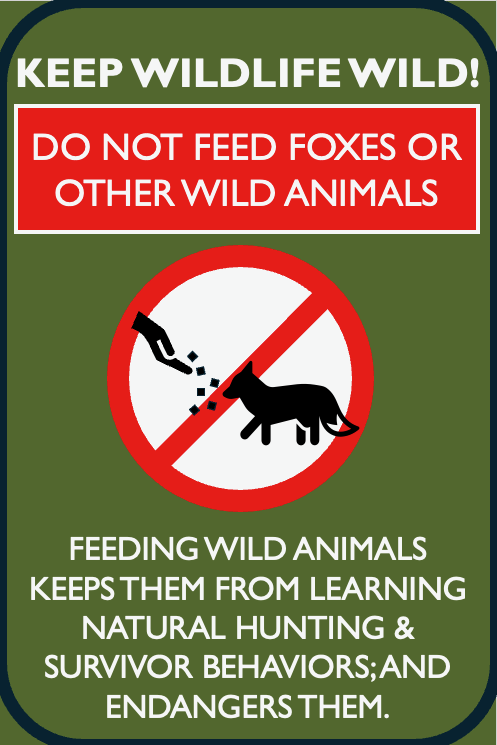
Sample sign for neighborhoods.
What Can I Do?
It is very important to know that relocation of wild animals is largely prohibited in North Carolina. Therefore, if there is a raccoon, skunk, fox, or coyote that you want removed, the only ones who will remove and not kill are wildlife rehabbers. Animal Control and Wildlife Removal Services are required by law to kill them (shoot them). We have listed some ideas below of how you can help prevent wildlife from becoming too familiar with human spaces and also keep their spaces safe and healthy!
-
Feeding wildlife can lead to serious health issues, diseases, and even death for these animals.
Wildlife can lose their natural fear of humans if they are fed. When they approach unfriendly individuals, this can lead to injury, death, and involvement of pest controllers that will euthanize.
Animals that are fed by humans become reliant on them and can stop hunting and foraging. When humans are not available, they will starve.
-
Keeping your distance is not just for your safety, but also the safety of wildlife. Getting too close to wildlife can cause unnecessary stress. Animals can get injured trying to escape away from people who get close, especially near roads. Also, both people and pets may have diseases that they can give to wildlife.
-
Leaving trash in nature causes severe, long-lasting harm by contaminating soil and water, endangering wildlife through ingestion or entanglement, and disrupting ecosystems.
Plastic debris breaks into harmful microplastics, lasting for hundreds of years. It also ruins the scenic beauty of natural spaces, creating pollution that lasts for generations.
-
If you see wildlife that is sick, injured, or orphaned, please call one of our local rescue and rehabbers. www.pleasureislandwildlife.com/team
(Seeing wildlife in the daytime does NOT mean they have rabies!)
-
Planting native plants is crucial because they support local biodiversity by providing essential food and habitat for native birds, pollinators, and wildlife. These plants are adapted to local climate and soil conditions, requiring less water, fertilizer, and pesticides, which saves resources and reduces pollution. They also help prevent soil erosion and strengthen ecosystems.
-
Turning off lights near beaches during nesting season is critical to prevent sea turtle hatchlings and nesting mothers from becoming disoriented by artificial light. Hatchlings rely on the natural, bright horizon of the ocean to navigate; artificial lights cause them to move inland, leading to exhaustion, dehydration, predation, or death.
Key Reasons to Turn Off Lights (Sea Turtles):
Prevent Disorientation: Artificial lights cause hatchlings and nesting females to move away from the ocean toward inland light sources.
Stop Predation & Hazards: Disoriented turtles often wander onto roads, get trapped in swimming pools, or become easy prey.
Encourage Natural Nesting: Female turtles prefer dark beaches; artificial light can discourage them from nesting.
Reduce Energy Loss: Misdirected turtles waste precious energy, reducing their chances of survival.
-
Bait boxes are harmful to wildlife primarily due to secondary poisoning, where predators and scavengers (owls, hawks, foxes) eat rodents that have consumed the poison. The poisons, often anticoagulant rodenticides, cause slow deaths over days, making rodents easy prey. This accumulates in the food chain, affecting over 25 species.
Key reasons bait boxes are hazardous to wildlife:
Secondary Poisoning: Predators like owls, eagles, and bobcats consume poisoned, slow-moving rodents, leading to illness or death.
Contamination: Second-generation anticoagulant rodenticides (SGARs) are highly toxic and persist in the bodies of animals.
Bioaccumulation: The toxins build up in the food chain, resulting in many predators testing positive for rat poison residues.
Primary Poisoning: Although designed for rodents, non-target animals (like squirrels or birds) can sometimes access the poison.
Slow Death: Rodents do not die immediately; they often leave the box, spreading the poison to the surrounding environment.
-
Support local organizations on Pleasure Island, or wherever you may live. These small nonprofits work hard because they care, but don’t always get the same recognition as larger organizations.